
Kerberos Mobile Energy — Power the Site. Not the Generator.
POWER THE SITE.
NOT THE
GENERATOR.
Kerberos Mobile BESS platforms are built to reduce generator runtime, fuel burn, maintenance cycles, noise, and low-load diesel operation on construction, oilfield, emergency response, and temporary industrial sites.
Estimated 250 kW Diesel Generator Fuel Use
24/7 Generator Runtime Burns Real Money
The savings are substantial because 24/7 diesel runtime burns far more fuel than needed when the generator can instead run only during charging windows or high-load periods.
Fuel-use values are approximate 250 kW diesel generator estimates. Actual fuel burn varies by generator model, age, load profile, site conditions, maintenance condition, and fuel quality.
The Hybrid BESS Business Case
More Energy. Less Fuel.
Hybrid generator + BESS systems let the battery carry low and variable loads while the generator runs only when recharge or extended runtime is required. Published field examples have shown major fuel savings, dramatic runtime reduction, and longer intervals between generator service events.
Up to 69% Fuel Savings
Documented fuel savings in published hybrid BESS examples
Runs 3.5 hrs vs. 24 hrs
Published case-study runtime versus continuous generator operation
60+ Days
Potential extension between 250-hour service events
Published Field Savings Example
Approx. Diesel Saved Per Month: 3,500 Gallons
In a 24/7 deployment, hybrid BESS operation can reduce generator runtime from continuous operation to only a few hours per day while also reducing service events, oil, filters, labor, truck rolls, noise, and wet-stacking exposure.
Delivered Diesel Assumption
$4.15
/ Gallon
Estimated Fuel Savings
~$14,525
Per Month
Annualized Fuel Savings
~$174,300
Per Year
Illustrative savings based on published hybrid BESS deployment results and estimated 250 kW generator fuel-use assumptions. Actual results vary by site.
Savings vary by site load profile, fuel cost, generator size, duty cycle, runtime reduction, maintenance schedule, and deployment duration. Final savings should be modeled per project.
RUN THE GENERATOR UP TO 69% LESS.
KEEP THE SITE 100% POWERED.
Kerberos Mobile Energy provides mobile battery energy storage systems for construction sites, oilfield sites, remote projects, and temporary power applications.
Our mobile BESS works beside your diesel or natural gas generator. The generator handles charging and heavy loads. The battery carries overnight, low-load, and variable-load demand such as jobsite trailers, lighting, pumps, HVAC, security systems, refrigeration, communications, and other critical temporary loads.
We are not asking you to replace your generators. We simply help them run fewer hours, burn less fuel, operate more efficiently, and SAVE YOU SUBSTANTIAL COSTS.
Why Add Battery Storage to Temporary Power?
Many temporary power sites run generators 24 hours per day, even when the actual overnight load is very small. This wastes fuel, adds unnecessary engine hours, increases maintenance, creates noise, and can contribute to wet-stacking when diesel generators run too lightly loaded.
A mobile BESS changes the operating profile. When site load is low, the battery carries the load and the generator shuts off. When the battery needs charging or site demand increases, the generator starts back up. This keeps the site powered while reducing unnecessary generator runtime.
Lower Fuel Burn
Fewer Service Calls
Quieter Overnight Power
REAL-WORLD Results
From 24 Hours Per Day to About 3.5 Hours Per Day
Public construction and equipment-rental studies show that hybrid BESS-and-generator systems can reduce generator runtime from continuous 24-hour operation to only a few hours per day on most jobsites. In a published BESS trailer deployment, a BESS and generator system powered multiple jobsite housing and office trailers and reduced average generator runtime to 3.5 hours per day.
Actual savings depend on site load, generator size, fuel price, weather, project duration, operating schedule, and how the system is configured. Kerberos models each project before deployment.
STOP RUNNING A DIESEL GENERATOR FOR SMALL LOADS.
Many field sites run diesel generators 24/7 even when the actual load is small, variable, or intermittent. That can waste significant fuel, add engine hours, shorten service intervals, increase noise, and contribute to generator damage when diesel engines run below healthy load levels.
A hybrid generator + BESS platform changes the operating cycle. The battery powers the site quietly for long periods, while the generator runs only when needed to recharge the battery or support extended runtime.
Generator-Only Temporary Power
- — Generator runs 24 hours per day even during low-load periods
- — 250-hour service interval can arrive about every 10 days
- — More fuel burn, more engine hours, more oil changes, more truck rolls
- — Low-load operation can contribute to wet stacking and engine damage
Hybrid Generator + BESS
- + BESS carries low and variable site loads quietly
- + Generator runs only for recharge or extended runtime
- + Generator can run under a healthier charging load when it is on
- + Lower runtime can reduce fuel burn, maintenance, noise, and downtime
Lower Fuel Burn
Instead of running a diesel generator lightly loaded around the clock, the generator can run in shorter charging windows while the BESS carries the site load.
Fewer Service Calls
A generator running 24/7 reaches a 250-hour service interval in about 10 days. Reducing runtime can push maintenance intervals much farther out and reduce oil, filter, labor, and truck-roll costs.
Healthier Generator Loading
Low-load diesel operation can lead to wet stacking and long-term engine problems. A BESS lets the generator run when it is actually needed, under a healthier charging load.
THE SIMPLE BUSINESS CASE
Generator-only temporary power burns fuel whether the site load needs it or not. A BESS-supported field site stores energy, supports load swings, reduces generator runtime, cuts maintenance exposure, lowers noise, and gives operators a more efficient way to power remote sites.
More energy when and where you need it. Less fuel wasted keeping a generator running when it is not needed.
.png)
FIELD POWER SOLUTIONS.
KME offers mobile BESS and hybrid generator-support platforms for temporary industrial power, construction, oilfield, emergency response, and rental markets.
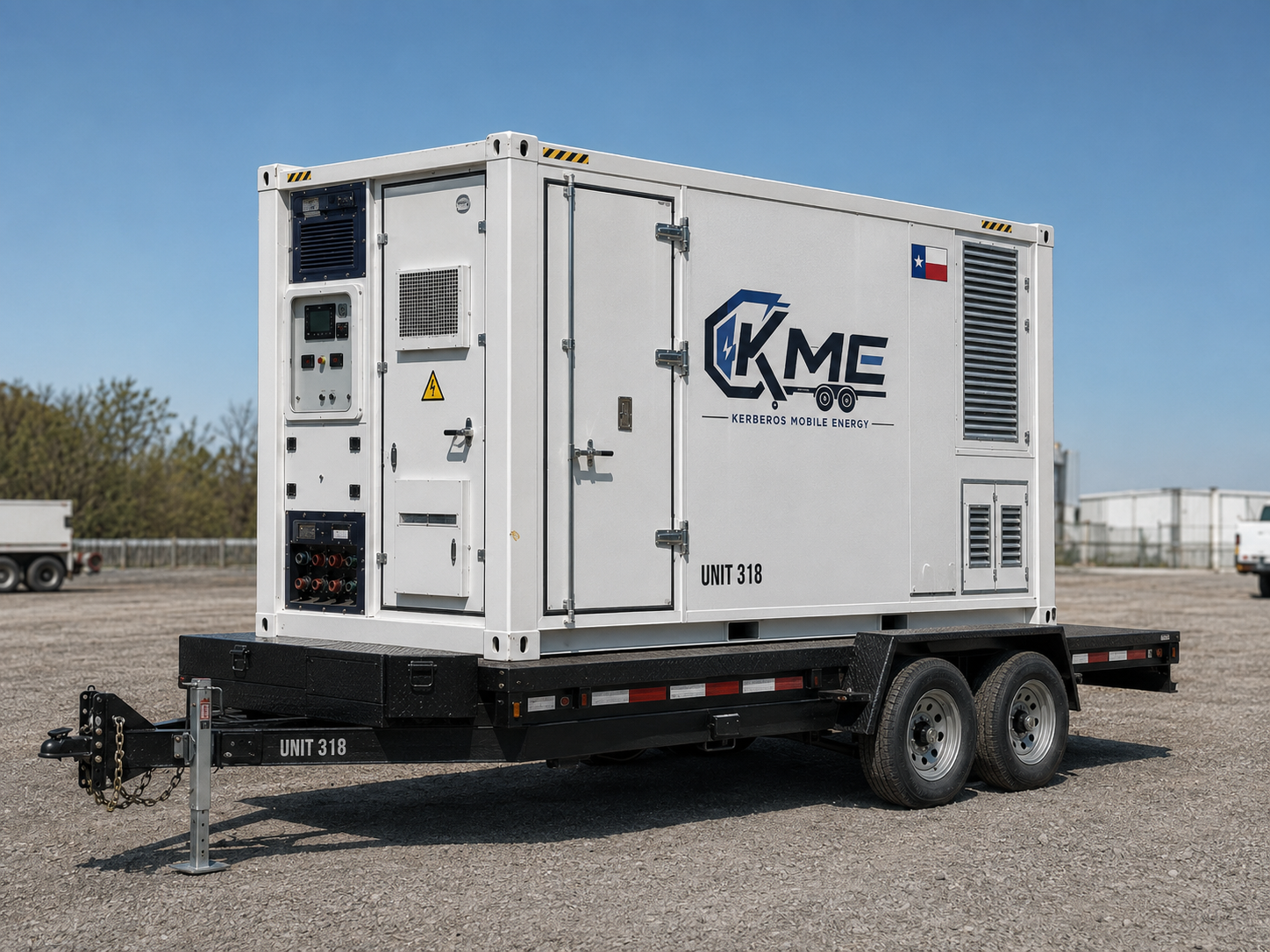
Mobile BESS Trailer
100–250 kW • 250–600 kWh • 480Y/277 V 3-Phase
Trailer-mounted battery energy storage platform designed for temporary industrial power, oilfield operations, construction sites, emergency response, and generator-supported field deployment.
View Platform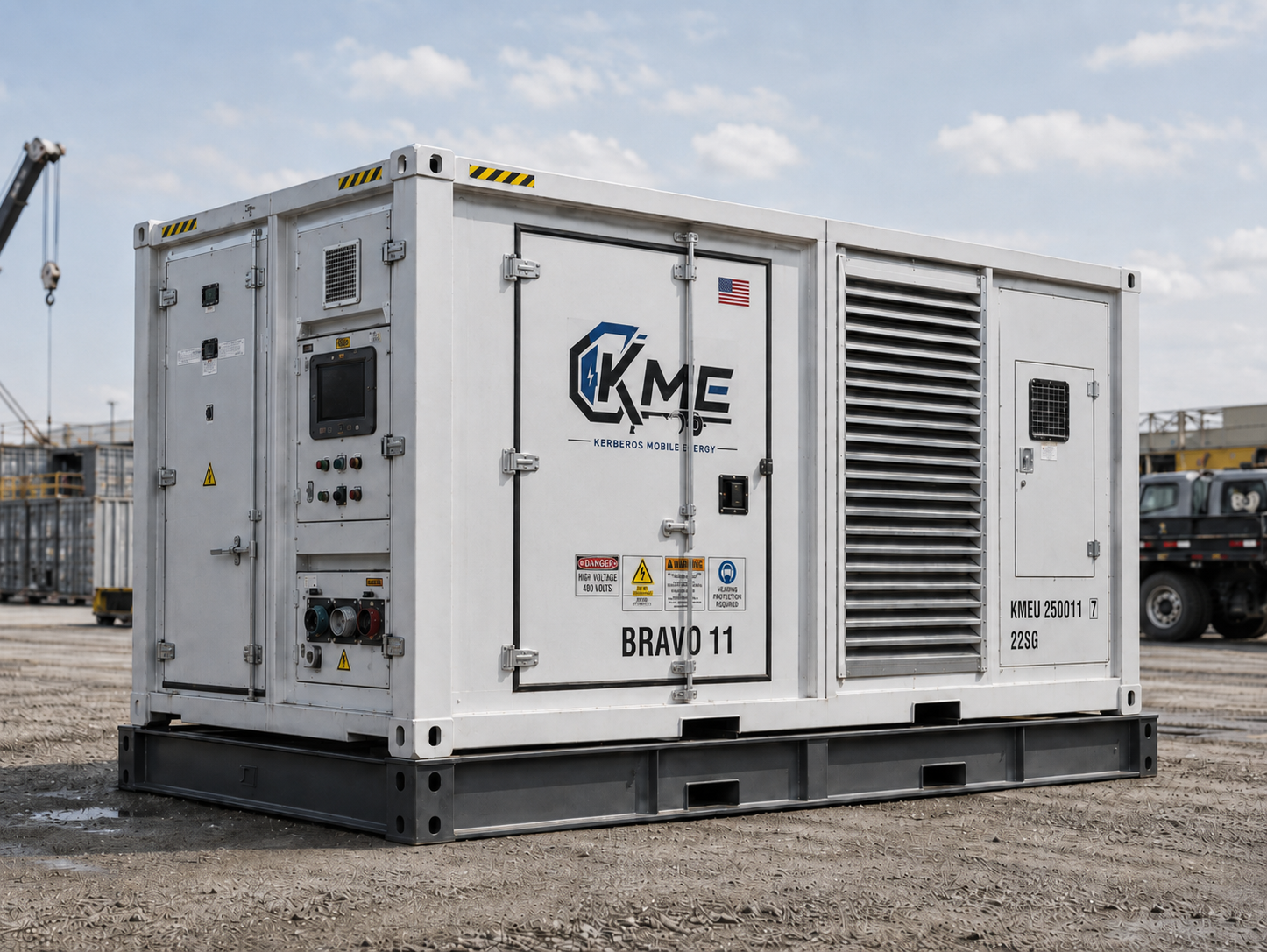
Containerized / Skid BESS Platform
250 kW+ • 500–700+ kWh • 480Y/277 V 3-Phase
Larger hybrid power platform available as a skid-mounted or containerized BESS system for project-based deployments and higher-capacity temporary industrial power.
View PlatformFIELD-PROVEN PLATFORM EXPERIENCE.
Kerberos Mobile Energy is the commercial mobile power division of Kerberos International, Inc., headquartered in Austin, Texas.
For the last decade, Kerberos has focused on serving as a sole-source support provider for Department of Defense, NATO, United Nations, NGO, and field-service organizations operating in remote, austere, and mission-critical environments. That work taught us how to build and support rugged mobile trailer and containerized systems that are lighter, faster to deploy, more cost-effective, and easier to operate in the field.
We are now bringing that same field-proven support capability into the commercial mobile power market. Kerberos Mobile Energy supports oilfield, construction, emergency response, temporary industrial power, and rental customers across Texas and surrounding regions — including Austin, Houston, San Antonio, Midland/Odessa, Dallas/Fort Worth, Tyler, and the broader Texas field-power corridor.
Our goal is simple: deliver better mobile power support at a lower total cost. We help customers reduce generator runtime, fuel burn, maintenance cycles, and jobsite noise without asking them to abandon the generators they already depend on.
NOT JUST A RESELLER.
Platform Experience
Kerberos has over a decade of experience building mobile and skid-mounted platforms and trailers for remote and austere field use.
Trailer & Integration Capability
Our team understands trailer design, transport constraints, field service access, power integration, and rugged deployment requirements.
Battery-First Field Power
Battery energy storage lets site loads run quietly from stored energy while the generator runs only when needed to recharge the system.
Trailer-Mounted BESS
Mobile BESS platform class designed for heavy-duty trailer integration.
Battery-First Operation
BESS carries site loads while generator runtime is reserved for recharge and extended operation.
Industrial Output
480Y/277 V three-phase output for industrial field loads and temporary power applications.
Remote Monitoring Ready
Monitoring capability for system status, operating data, and field support visibility.
BUILT FOR THE TOUGHEST SITES.

Oilfield
Wellsite power, remote production, and field support applications.

Construction
Temporary site power for large-scale builds and remote work areas.

Emergency Response
Deployable power for disaster response and critical infrastructure support.

Temporary Industrial
Remote industrial operations, yard power, and temporary infrastructure.
READY TO TALK THROUGH YOUR SITE?
Request information on our mobile BESS trailer or containerized BESS platform. Tell us your project location, generator size, daily runtime, loads powered, and whether you are considering rental or purchase.